
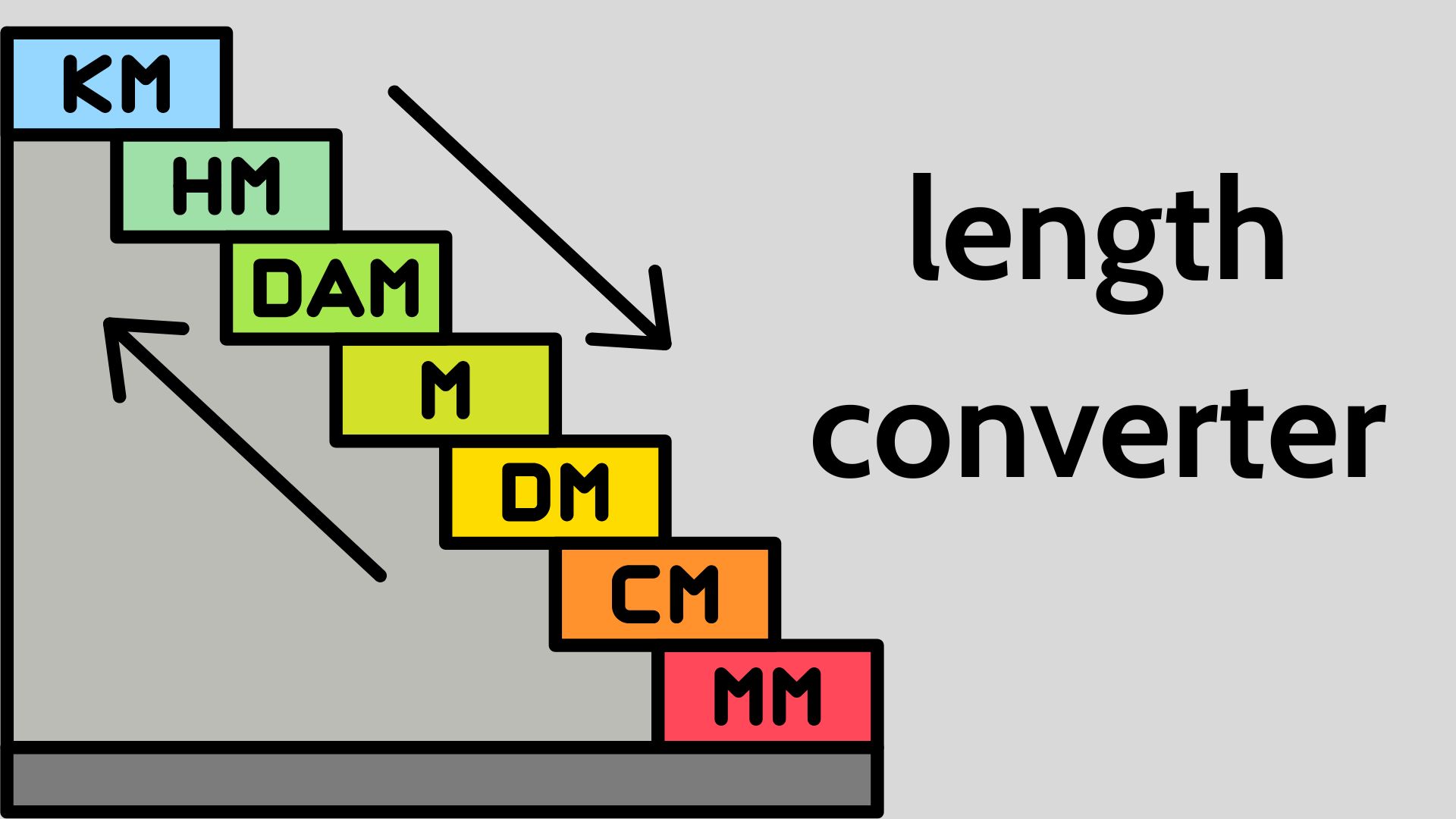
How to Use a Length Converter Tool
A Length Converter tool helps you convert a length measurement from one unit to another easily. Follow these steps:
Step 1: Select the Original Unit
Choose the unit of the value you want to convert from. For example, select meters (m).
Step 2: Select the Target Unit
Now choose the unit you want to convert to. For example, select feet (ft) if you want to convert meters to feet.
Step 3: Enter the Value
Type the number you want to convert into the input box. For example, type 10 if you want to convert 10 meters.
Step 4: View the Result
The converter will instantly show the result. Example:
10 meters = 32.8084 feet
Step 5 (Optional): Try More Conversions
You can convert other values or select different units as needed. Common units include:
-
millimeters (mm)
-
centimeters (cm)
-
meters (m)
-
kilometers (km)
-
inches (in)
-
feet (ft)
-
yards (yd)
-
miles (mi)

I. Introduction
A length converter is a practical tool used to convert one unit of length to another. Whether you’re working on a home improvement project, studying for an exam, or traveling internationally, understanding length conversions is essential. This guide will walk you through the basics and complexities of converting lengths between various units, equipping you with knowledge and tools to handle any length conversion scenario.
II. Understanding Units of Length
Length is one of the most fundamental measurements used across science, engineering, construction, daily life, and international trade. Here’s an overview of the most commonly used units of length, organized by system:
1. Metric Units (SI – International System of Units)
Widely used around the world and based on powers of 10, metric units are simple to convert between.
| Unit Name | Symbol | Equivalent |
|---|---|---|
| Millimeter | mm | 1 mm = 0.001 meters |
| Centimeter | cm | 1 cm = 10 mm = 0.01 meters |
| Meter | m | Base unit of length in SI |
| Kilometer | km | 1 km = 1,000 meters |
Usage:
-
Millimeters and centimeters: engineering drawings, medical instruments
-
Meters: height, distance in daily use
-
Kilometers: long-distance travel, maps, and speed limits
2. Imperial and U.S. Customary Units
Primarily used in the United States and a few other countries.
| Unit Name | Symbol | Equivalent |
|---|---|---|
| Inch | in | 1 in = 2.54 cm |
| Foot | ft | 1 ft = 12 in = 0.3048 meters |
| Yard | yd | 1 yd = 3 ft = 0.9144 meters |
| Mile | mi | 1 mi = 1,760 yd = 1.60934 km |
Usage:
-
Inches and feet: building dimensions, personal height, product specs
-
Yards: sports fields, fabric lengths
-
Miles: road distances, running races
3. Specialized and Scientific Units
Used in astronomy, maritime navigation, or specific technical fields.
| Unit Name | Symbol | Equivalent |
|---|---|---|
| Nautical Mile | nmi | 1 nmi = 1.852 km |
| Fathom | – | 1 fathom = 6 ft = 1.8288 m |
| Hand | – | 1 hand = 4 inches (used to measure horse height) |
| Micrometer | µm | 1 µm = 10⁻⁶ m |
| Nanometer | nm | 1 nm = 10⁻⁹ m |
| Angstrom | Å | 1 Å = 0.1 nm = 10⁻¹⁰ m |
| Light-Year | ly | 1 ly ≈ 9.461×10¹² km |
| Astronomical Unit | AU | 1 AU ≈ 149.6 million km |
| Parsec | pc | 1 pc ≈ 3.26 light-years |
Usage:
-
Nanometers and micrometers: electronics, nanotechnology, biology
-
Light-years and AU: astronomy
-
Fathoms and nautical miles: marine navigation
These units are crucial in different contexts and industries. Understanding and converting between them is where the length converter tool becomes invaluable.
III. Common Length Conversion Formulas
A. Metric to Metric
- 10 mm = 1 cm
- 100 cm = 1 m
- 1000 m = 1 km
B. Imperial to Imperial
- 12 inches = 1 foot
- 3 feet = 1 yard
- 1760 yards = 1 mile
C. Metric to Imperial
- 1 cm = 0.3937 in
- 1 m = 3.2808 ft
- 1 km = 0.6214 mi
D. Imperial to Metric
- 1 in = 2.54 cm
- 1 ft = 0.3048 m
- 1 mi = 1.609 km
E. Scientific Units
- 1 um = 0.000001 m
- 1 nm = 0.000000001 m
- 1 light-year = 9.461 x 10^12 km
IV. Key Length Conversion Categories
Length conversions fall into several major categories, depending on the unit systems involved and the level of precision needed. Understanding these categories helps users select the right conversion method and apply it correctly across various fields—from science to everyday life.
1. Metric to Imperial Conversions
Used when converting between the globally dominant metric system and the U.S. customary or imperial system.
| Metric Unit | Converts To |
|---|---|
| Millimeter (mm) | Inches (in) |
| Centimeter (cm) | Inches (in) |
| Meter (m) | Feet (ft), Yards (yd) |
| Kilometer (km) | Miles (mi) |
Examples:
-
10 cm = 3.937 in
-
1 m = 3.28084 ft
-
5 km = 3.10686 mi
2. Imperial to Metric Conversions
For use in international trade, scientific research, or travel where metric standards are used.
| Imperial Unit | Converts To |
|---|---|
| Inch (in) | Millimeter (mm), cm |
| Foot (ft) | Meter (m) |
| Yard (yd) | Meter (m) |
| Mile (mi) | Kilometer (km) |
Examples:
-
12 in = 30.48 cm
-
3 ft = 0.9144 m
-
1 mi = 1.60934 km
3. Intra-Metric Conversions
Conversions within the metric system are straightforward, based on factors of 10.
| From | To | Factor |
|---|---|---|
| Millimeter | Centimeter | ÷ 10 |
| Centimeter | Meter | ÷ 100 |
| Meter | Kilometer | ÷ 1,000 |
Examples:
-
1000 mm = 1 m
-
500 cm = 5 m
-
3000 m = 3 km
4. Intra-Imperial Conversions
Used in the U.S. and UK for day-to-day measurements, especially in construction, real estate, and textiles.
| From | To | Factor |
|---|---|---|
| Inch | Foot | ÷ 12 |
| Foot | Yard | ÷ 3 |
| Yard | Mile | ÷ 1760 |
Examples:
-
36 in = 3 ft
-
3 ft = 1 yd
-
5280 ft = 1 mi
5. Scientific & Astronomical Conversions
Used for extremely small or large distances in nanotechnology, astronomy, or physics.
| From | To | Usage Example |
|---|---|---|
| Nanometer (nm) | Micrometer (µm) | Wavelength of visible light |
| Micrometer (µm) | Millimeter (mm) | Cell size in biology |
| Light-Year | Kilometer (km) | Distances between stars |
| AU (Astronomical Unit) | km | Earth to Sun distance |
| Parsec (pc) | Light-Year | Galactic distances |
6. Niche & Industry-Specific Conversions
Used in fields like navigation, horse measurement, and surveying.
| Unit | Converts To | Used In |
|---|---|---|
| Fathom | Meter | Marine depth |
| Nautical Mile | Kilometer | Marine and air navigation |
| Hand | Inch | Measuring horse height |
| Chain | Meter | Land surveying |
These categories serve as the foundation for how a length converter tool organizes its logic. By choosing the right conversion path, users can ensure precision and relevance in their calculations.
V. Conversion Tables
A. Metric Conversion Table
| mm | cm | m | km |
|---|---|---|---|
| 1000 | 100 | 1 | 0.001 |
B. Imperial Conversion Table
| in | ft | yd | mi |
| 12 | 1 | 0.333 | 0.000189 |
C. Metric to Imperial Conversion Table
| Metric | Imperial |
| 1 cm | 0.3937 in |
| 1 m | 3.2808 ft |
| 1 km | 0.6214 mi |
D. Imperial to Metric Conversion Table
| Imperial | Metric |
| 1 in | 2.54 cm |
| 1 ft | 0.3048 m |
| 1 mi | 1.609 km |
VI. Benefits of Using a Length Converter Tool
A length converter tool offers significant advantages in both professional and everyday settings. Whether you’re an engineer working on a blueprint, a student solving math problems, or a traveler interpreting foreign road signs, this tool helps ensure precision, speed, and convenience when switching between different units of measurement.
1. Accuracy and Precision
-
Eliminates the risk of manual calculation errors.
-
Uses predefined formulas and constants (e.g., 1 inch = 2.54 cm) for consistent results.
-
Particularly important in fields like engineering, architecture, and science, where even small miscalculations can cause big problems.
2. Time-Saving
-
Provides instant results with just a few clicks or taps.
-
No need to memorize complex conversion factors or do long division.
-
Efficient for multi-unit conversions (e.g., convert 10 meters into feet, inches, and yards simultaneously).
3. User-Friendly and Accessible
-
Most tools are designed for ease of use, with drop-down menus and auto-calculation features.
-
Available online, as mobile apps, or even as embedded widgets on websites.
-
Can be used by anyone—students, professionals, DIYers, travelers, etc.
4. Supports Global Communication and Trade
-
Helps standardize units across different countries using metric or imperial systems.
-
Ensures clear communication in global businesses, product specs, and import/export documentation.
-
Essential for international collaboration in construction, manufacturing, and design.
5. Eliminates Guesswork
-
Provides confidence in measurements without needing to estimate or round unnecessarily.
-
Especially helpful when purchasing materials or parts that require exact lengths (e.g., plumbing pipes, cables, fabric).
6. Enhances Learning and Education
-
Assists students in learning how to convert units and check their work.
-
Useful for teachers preparing lessons in physics, math, or geography.
-
Allows students to explore and compare units from different systems in real-time.
7. Supports Specialized and Scientific Work
-
Converts rare or advanced units like light-years, nanometers, or astronomical units.
-
Useful in disciplines such as astronomy, nanotechnology, geology, and marine science.
-
Helps researchers and scientists avoid scaling mistakes when working with extremely large or small measurements.
8. Multi-Platform Availability
-
Works across various platforms: web browsers, smartphones, tablets, and desktops.
-
Many tools support offline use, making them reliable in the field or in locations with limited internet access.
9. Customization and Multi-Functionality
-
Some advanced tools let users set precision levels, save conversions, or integrate with CAD or spreadsheet software.
-
Can include batch conversions, where multiple values are converted at once.
10. Peace of Mind
-
Offers users the confidence that their dimensions, plans, or purchases are based on accurate information.
VII. Real-Life Applications of Length Conversion
Length conversion is a practical necessity in everyday life, business, and technical fields. Whether you’re measuring your room, working on an international engineering project, or shopping online, converting between units like meters, inches, or feet ensures clarity, precision, and compatibility across different standards and contexts.
1. Construction and Architecture
-
Blueprints and Floor Plans often use meters or feet, depending on the country.
-
International projects require engineers to convert between metric (meters, cm) and imperial (feet, inches) units to avoid structural errors.
-
Furniture fitting, room layout, and material estimates depend heavily on accurate conversions.
🛠️ Example: A 3-meter ceiling height must be converted to ~9.84 feet for a U.S.-based contractor.
2. Engineering and Manufacturing
-
Mechanical parts designed in one system (e.g., millimeters) may be manufactured in another (e.g., inches).
-
Tolerances in component sizes require micron-level precision, demanding accurate unit conversions.
-
Conversions ensure global compatibility in automotive, aerospace, electronics, and civil engineering.
⚙️ Example: A gear shaft designed to be 0.5 inches must be translated to 12.7 mm for CNC programming.
3. Online Shopping and E-Commerce
-
Many online stores list product sizes in local units.
-
Customers often convert clothing sizes, furniture dimensions, or screen sizes to understand them better.
-
Sellers also need to adjust listings for global markets.
🛍️ Example: A shoe listed as 10 inches long converts to ~25.4 cm for European customers.
4. Travel and Navigation
-
Road signs and GPS in the U.S. use miles, while most other countries use kilometers.
-
Nautical miles are used in marine and aviation navigation.
-
Travelers convert kilometers to miles, meters to feet, or feet to meters to understand directions and altitudes.
✈️ Example: A hiker planning a 12-mile trek in Europe may convert it to about 19.3 km.
5. Education and Homework
-
Students in science or math often convert lengths as part of physics problems or geometry.
-
Teachers use conversions to explain unit systems and real-world applications.
-
Educational tools and quizzes rely on accurate formulas.
📚 Example: A question asks to convert 120 inches to meters (~3.048 m) for a physics lab.
6. Fashion and Tailoring
-
International fashion brands use different size charts (inches, cm).
-
Tailors need to convert lengths for measurements, fabric cuts, and fitting details.
👗 Example: A tailor converting a 42-inch chest measurement to centimeters (≈106.68 cm) for a suit order.
7. Real Estate and Property Listing
-
Room dimensions, ceiling heights, and lot sizes are presented in local units.
-
Buyers, sellers, and agents convert sizes to compare properties globally.
🏡 Example: A 1,500 sq ft apartment is listed in Europe as ~139.35 square meters.
8. Sports and Fitness
-
Running tracks, swimming pools, and gym equipment use different units.
-
Athletes convert track lengths, race distances, or jump measurements for training.
🏃 Example: A 5K run is equivalent to 3.1 miles.
9. Science and Astronomy
-
In research, scientists convert between micrometers, nanometers, and light-years.
-
Astronomical units like parsecs and AU need translation into kilometers or miles for understanding.
🔭 Example: A telescope detects an object 4 light-years away (~37.8 trillion km).
10. Home Renovation and DIY Projects
-
Measuring pipes, wood, tiles, or wall areas often involves mixed units.
-
DIYers need to convert inches to cm, feet to meters, etc.
🔨 Example: Installing a shelf that is 30 inches wide = ~76.2 cm.
VIII. Tips for Accurate Length Conversion
Converting length units accurately is crucial in technical work, education, and everyday use. A small mistake—like misapplying a conversion factor or rounding too soon—can lead to costly errors. Here are some essential tips to ensure precision and reliability when using a length converter tool or doing conversions manually:
1. Know the Correct Conversion Factor
-
Always verify the standard conversion rate before starting.
-
Example: 1 inch = 2.54 centimeters (not 2.5!)
-
1 foot = 0.3048 meters
-
-
Use official and standardized values, especially in technical or scientific fields.
2. Use a Reliable Length Converter Tool
-
Choose tools from trusted sources or apps with good reviews.
-
Look for:
-
Customizable decimal places
-
Multi-unit conversion support
-
Offline access (if needed)
-
3. Be Mindful of Unit Symbols
-
Don’t confuse similar abbreviations:
-
m (meter) vs mm (millimeter)
-
in (inch) vs ft (foot)
-
nm (nanometer) vs nmi (nautical mile)
-
-
Double-check which unit you’re inputting and outputting.
4. Maintain Consistent Units in Calculations
-
In multi-step problems, ensure all measurements are in the same unit system before adding, subtracting, or comparing.
-
Example: Don’t mix centimeters and inches without converting first.
-
5. Don’t Round Too Early
-
Round only at the final step unless instructed otherwise.
-
Early rounding can compound errors—especially in engineering or manufacturing.
6. Use Significant Figures Where Applicable
-
Match the precision level to the application.
-
Scientific work may require 4–5 significant digits.
-
Everyday use may only need 1–2 decimal places.
-
7. Document the Conversion Process
-
In technical or academic work, show your steps:
-
The original value
-
The conversion factor used
-
The result and units
-
-
This increases transparency and reduces misunderstanding.
8. Use Physical References When Needed
-
Keep a conversion chart or dual-unit ruler nearby for quick reference.
-
Handy for fieldwork or low-tech environments.
9. Watch Out for Regional Differences
-
Be aware of unit variations in different countries:
-
The UK uses both imperial and metric (e.g., miles for roads, meters for building plans)
-
U.S. mostly uses imperial (feet, inches), while the rest of the world prefers metric.
-
10. Practice with Real Examples
-
Improve your confidence and speed by practicing conversions:
-
Room sizes, screen dimensions, map distances, etc.
-
-
This reinforces your familiarity with key conversion rates.
✅ Pro Tip:
If accuracy is critical (e.g., in medical, aviation, or structural design), always double-check the result using a second tool or manual formula.
IX. Developing a Length Converter (For Developers)
A. Basic HTML/JS Example
Use dropdowns, text inputs, and a button with event listener
B. Backend Integration
Use Python or PHP for server-side conversion engines
C. API Support
Integrate Google or custom APIs for robust functionality
D. UI/UX Best Practices
Make interfaces simple, mobile-friendly, and responsive
X. Frequently Asked Questions (FAQs)
1. What is a length converter tool?
A length converter tool is a digital calculator or app used to convert one unit of length into another—such as from inches to centimeters or kilometers to miles. It ensures quick and accurate results, especially useful in engineering, science, and everyday tasks.
2. How accurate are length converter tools?
Most reputable tools are highly accurate because they use internationally recognized conversion factors (e.g., 1 inch = 2.54 cm). However, rounding settings can affect results, so choose tools that allow you to set precision levels if needed.
3. Do I need an internet connection to use a length converter?
Some tools are web-based and require internet, but many mobile apps and offline tools can function without a connection. For consistent access, consider installing a mobile app or downloading a spreadsheet-based converter.
4. Can a length converter handle scientific units like light-years or nanometers?
Yes. Advanced converters support scientific and astronomical units such as nanometers, micrometers, angstroms, light-years, astronomical units (AU), and parsecs.
5. Are there physical alternatives to digital length converters?
Yes. Physical conversion charts, rulers with dual-unit markings, or engineering reference books often include length conversion tables. These are helpful in fieldwork or low-tech environments.
6. Can I convert multiple units at once?
Many online tools and apps allow multi-unit output, meaning you can enter a value in meters and get results in feet, inches, and yards simultaneously.
7. Is it better to use a general unit converter or a dedicated length converter?
If you’re only dealing with length, a dedicated length converter is faster and more focused. However, for broader use (e.g., weight, volume, temperature), a general converter is more versatile.
8. Are all length converter tools free?
Most basic tools are free. However, some premium apps or engineering software offer more advanced features, like batch conversions, unit customization, or integration with CAD tools.
9. How do I convert length manually without a tool?
Use known conversion formulas. For example:
-
Inches to cm: multiply by 2.54
-
Feet to meters: multiply by 0.3048
Keep a small conversion chart or memorize key factors for frequent conversions.
10. What are the most common mistakes in length conversion?
-
-
Confusing units (e.g., foot vs meter)
-
Forgetting to switch between metric and imperial
-
Incorrectly applying the formula
-
Rounding too early in complex calculations
-
XI. Conclusion
Mastering length conversions is invaluable for daily tasks, education, engineering, and beyond. Whether using tools or calculating by hand, the key lies in understanding units and their relationships. With this comprehensive guide, you are now equipped to handle all your length conversion needs confidently and accurately.